Resonance
science, sound and the ancient past

Archaeo-acoustics. You might never have heard of it before - I hadn’t!
As the parts of the word suggest, it is about the study of sound in the ancient past. There’s something almost defiantly hasn’t-that-horse-already-bolted? about this as an idea. How can you investigate sound in the past, before the age of sound recording? Reading a New Scientist article recently, I began to understand that researchers are finding ways to add rigour to work that has sometimes seemed too subjective for scientific study. Their painstaking methods and technologies have gradually earned the right for the results of field studies to be taken seriously.
For prehistoric rock art sites a core idea to many acoustic archaeologists is that the majority of locations were selected in part because of unusual acoustic properties. Some sites are exceptionally resonant while others also have very long ‘sustain times’. Some have unusual sound reflecting characteristics that can instil the unnerving sensation of another presence.
When modern visitors go to see rock or cave art locations we are often speak in reverend whispers - as if in an art gallery, or even a church. Ironically this is not the best way to experience the acoustic of a space as early humans might have done. Whether with singing, drums, clapping, or flutes - that kind of experience is brought alive through making sound. It is almost as if there is an open secret within the space itself – an unexpectedly open door towards lives in our most distant past. To step through, we must break the silence, and be prepared to listen and experience what comes back.
Researchers working with replica instruments in ancient rock art sites report that ‘completing’ the instrument by playing in these spaces can give a somewhat ‘polite’ sound, like that of a bone flute, far more depth and volume - making a cave itself sing. Here is a mesmerising clip of flautist Anna Friedericke Potengowski playing a replica bone flute in the bone flute in the Hohle Fels cave –
Links to the New Scientist article by Benjamin Taub that I was reading, and recordings by Anna Friedericke Potengowski are given at the end of this post.
~
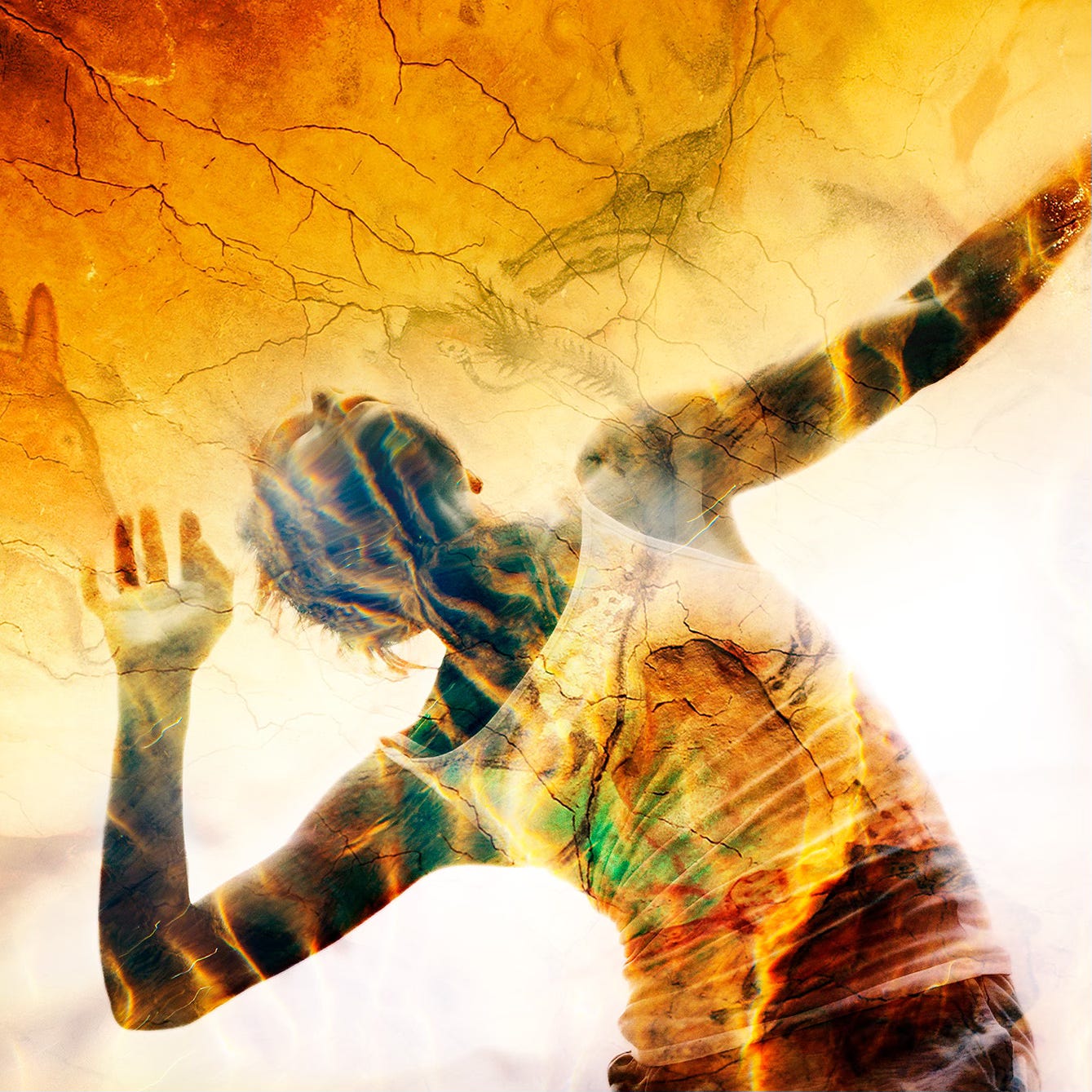
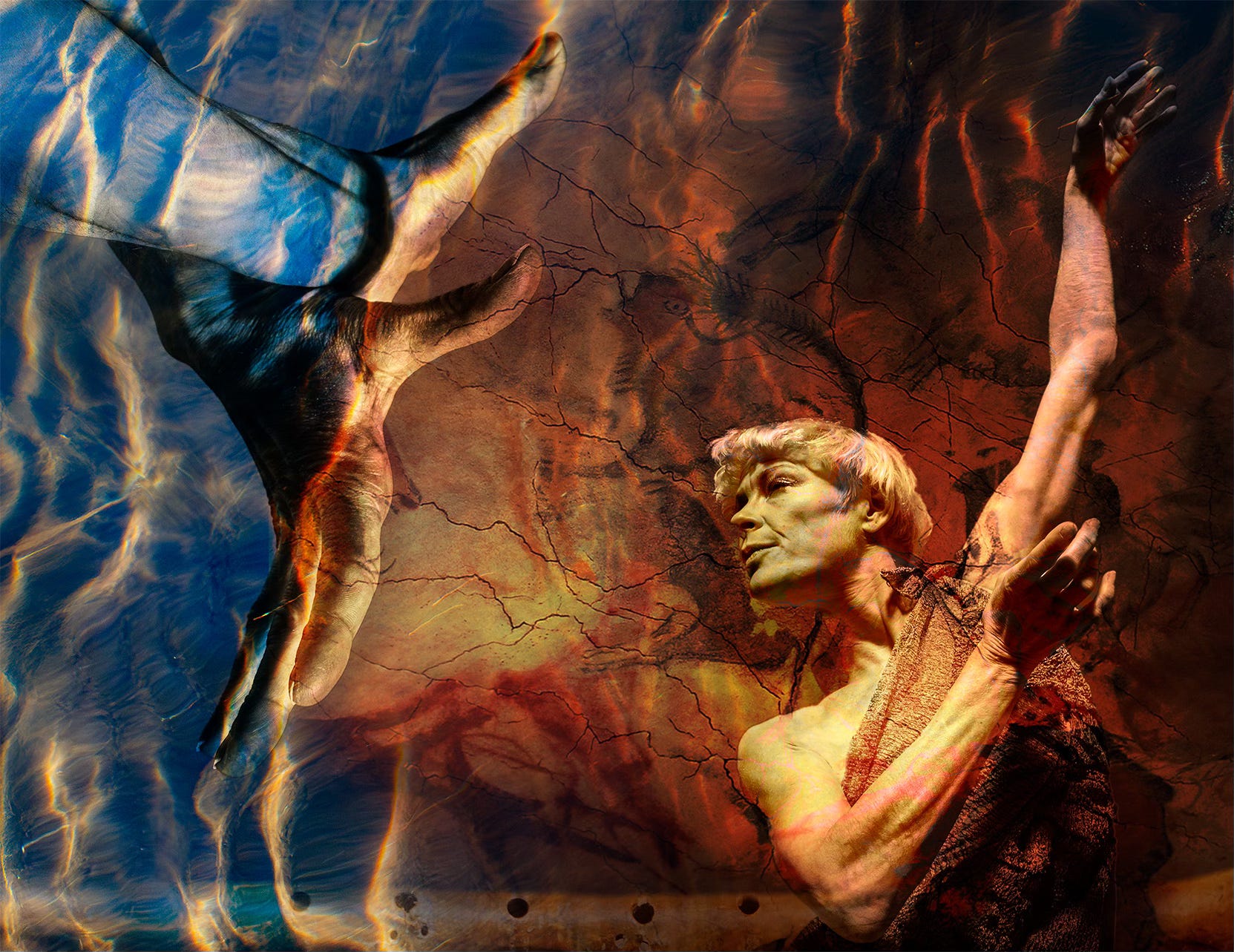
I found all these ideas highly resonant. I made some visual art working with images from a video shoot for a poetry film a couple of years ago with dancer Suzi Cunningham. I felt Suzi’s movement had a ritualistic - almost shamanic quality that fitted well here. As well as rock art, I used another image of the surface of a remote highland lochan. For me that symbolises both a wave, like sound, propagating, but also a traditional kind of portal. A way to think into another.
Then I wrote the poem. It references the ideas above, and tries to fuse experiences of seeing and hearing at an ancient rock art site. There is a kind of synesthesia going on, where the colour and sounds intermingle to reveal something that may previously have remained hidden.
~
Resonance
In darkness’s drum-struck umbers
hand-clap herd-thrum, under-sky rolling.
In still ice flutes blue-bone green and splinter,
a river seasoned through high cascades.
Coming to this under-cut cliff-face
you must emancipate a shadow life –
stone-ghost vague in shallow light,
an echo-self sketched from crimson beats.
Your reverent whisper pales to chime
our galleries around, above, aloud and ochre.
Hold – strike a baritone, song-cast high in amber,
sway and russet. Hear again and listening, see.
Notes
We can finally hear the long-hidden music of the Stone Age
Benjamin Taub, New Scientist 18/11/2025
The Edge of Time: Palaeolithic bone flutes from France & Germany,
Delphian (on Spotify, also available elsewhere)
.
.
Love thinking about resonance and ancient sound. Thank you Steve.